Thursday, November 26, 2020

Justice Amy Coney Barret cements Christian Privilege for an Activist Christian Nationalist Supreme Court


My fears of Christian Nationalism and Christian Privilege with the addition Justice Amy Coney Barrett are realized in Roman Catholic Diocese of Brooklyn v. Cuomo -- a Supreme Court decision issued yesterday. In a 5-4 decision (Thomas, Alito, Gorsuch, Kavanaugh and Barrett in the majority), the State of New York is enjoined from enforcing its #Covid-19 restrictions against churches based on a moronic interpretation of the Free Exercise Clause of the First Amendment. 

Under Employment Division v. Smith (1990), "the right of free exercise does not relieve an individual of the obligation to comply with a 'valid and neutral law of general applicability on the ground that the law proscribes (or prescribes) conduct that his religion prescribes (or proscribes).' " 

So what did the gang of Christian nationalists do, they (1) failed to defer to state health officials with expertise and (2) falsely parsed the pool of secular comparables (i.e., instead of comparing churches to theaters, etc. where people are in close proximity for extended periods of time, the Court majority compared them to retail stores where people are more spread out and move about -- the former having greater restrictions, the latter less restrictive). 

Essentially, the Supreme Court has weaponized the Free Exercise Clause to promote Christian privilege.

By: Robert V. Ritter, Founder, Jefferson Madison Center for Religious Liberty, November 26, 2020

Monday, October 12, 2020

Senate Republican Hypocrisy on Religious Test for Public Office

I listened to the opening statements of Senators in the confirmation hearing of Judge Amy Barrett for a seat on the U.S. Supreme Court and the judge's opening remarks.

Democratic Senators exclusively focused their remarks on the Affordable Care Act (ACA) and Judge Barrett's opposition to it. Notably, they avoided commenting on her faith based speeches, writings and judicial opinions that are constitutionally problematic.

Democratic Senators also avoided the shameful hypocrisy of those who invoke the No Religious Test Clause of Article VI of Constitution.

Clause 3 of Article VI states in part: "no religious Test shall ever be required as a Qualification to any Office or public Trust under the United States." In reality, it's as if there are "No Atheists" plaques at the entrances of Congress, the White House and the Supreme Court. Religious affiliation allows one to get in line, without it you need not apply.

As an Atheist, I strongly support the No Religious Test Clause (when coordinated with the Establishment Clause). Unfortunately, religious tests are often the standard, not the exception. For example, Christian privilege has eviscerated the clause with politicians ending their speeches with "God bless America and God bless the United States of America."

It is important to note that the clause does not exist in isolation. The clause must be balanced with the Establishment Clause of the First Amendment. The Establishment Clause prohibits government from preferring one religion over another, or religion over nonbelief

Judge Barrett's nomination raises a conflict between the two clauses. Do her religious views disqualify her from a seat on the Court? "Views," religious or not, do not disqualify a nominee from an appointment to the Court.  However, using religious views to decide one way or another would. Of particular concern is Judge Barret's view of Roe v. Wade and whether her Catholic faith would be the impetus for her voting to overturn Roe.

President Trump has said a number of times that he has a litmus test for nominating a justice to the Supreme Court. Specifically, Trump has said that he would not nominate a person who supports either Roe v. Wade or the Affordable Care Act. Because opposition to Roe (abortion) and the ACA (birth control) is based on religious tenets of the Catholic Church and certain other religions, Trump's nomination of Judge Barrett, in my opinion, violates the No Religious Test Clause because Trump used a religious test to choose her.

With respect to those Senators who oppose Judge Barrett's nomination on the basis of her speeches, writings and judicial opinions because they sincerely believe that a Justice Barret will use her position on the Court to advance her Catholic faith in violation of the Establishment Clause -- those objections are appropriate and not a violation of the No Religious Test Clause because Barrett's nomination itself is a violation of the clause. 

Indeed, failure to reject Barrett's nomination would mean that the Senators lack fidelity to the Constitution to protect and defended the Constitution against people like Judge Barrett (and the late Justice Scalia) whose Catholicism, when implemented thru her rulings, would undermine the Establishment Clause and our religious freedom.

By: Robert V. Ritter, Founder, Jefferson Madison Center for Religious Liberty, October 12, 2020

Saturday, July 11, 2020

Establishment Clause: What's the test -- separation or neutrality?

The Supreme Court's June 30th decision in Espinoza v.Montana Department of Revenue:exposes the weakness of the Bill of Rights, namely, its vagueness. With respect to Espinoza, it's the vagueness of the religion Clauses that allows justices to interpret them according to .their own world views.

In the First Congress -- on June 8, 1789 -- Representative James Madison (Va.) proposed a bill of rights. A House committed on which Madison served considered his proposals, made some changes and the House its version of a bill of rights. The Senate took up the House bill and made some modifications. Madison served on the House-Senate conference committee and insisted on the House's version of the First Amendment. Senate negotiaters accepted the House's version of the First Amendment in exchange for some of its wording in other amendments. The states ratified ten of Congresses twelve proposals on December 15, 1791, including the religion clauses of the First Amendment:

Congress shall make no law respecting an establishment of religion or prohibiting the free exercise thereof ...

Madison promised during the ratification process of the Constitution that he would propose a bill of rights to fill a void that many felt was lacking in the Constitution.

The First Congress was very busy establishing a new form of government, leving little time for lower priority bill of rights. Tho there is little recorded of the committees discussions, one thing is clear that the Establishment Clause meant much more than prohibiting Congress from establishing a national religion. We know this because that proposal was voted down in the House committee.  Similarly, a proposal prohibiting Congress from enacing a law anything "touching religion" was likewise voted down. 

Where does that leave us as to the meaning of the Establishment Clause? Specifically, what does "an establishment of religion mean??

Textualism does not guuide us in interreting the Establiysment Clause because of its vaguendess. Secifically, "an establishment of religion" was not a phrase with establishmed meaning in 1789. What is clear, at least to me, is "an" is broad rather than narrow.

By: Robert V. Ritter, Founder, Jefferson Madison Center for Religious Liberty, July 11, 2020

Thursday, July 9, 2020

Justice Breyer flip-flops on time makiing a wrong right

Justice Gorsuch, writing for the majority in McGirt v. Oklahoma, said today: "Unlawful acts, performed long enough and with sufficient vigor, are never enough to amend the law. To hold otherwise would be to elevate the most brazen and longstanding injustices over the law, both rewarding wrong and failing those in the right." 

I agree with both the Court's decision in McGirt and Justice Gorsuch's statement. Fifteen years ago, Justice Breyer, who signed on to Justice Gorsuch's opinion, had a different view in Van Orden v. Perry (2005). Justice Breyer concurred in the judgement in Van Orden, joining four Christian nationalist justices in holding that a 1961 Fraternal Order of Eagles Ten Commandments monument on the grounds of the Texas State Capitol did not violate the Establishment Clause because it had been on the Capitol grounds for 44 years. 

In other words, in Van Orden, Justice Breyer opined that a wrong (i.e., a religious monument on public property) should be allowed to stay (i.e., go uncorrected) because the passage of time is an alchemy for making a wrong right (or, simply, let sleeping dogs lie). Hypocrisy at its finest -- in the Supreme Court of the United States. 

Bottom line: the Van Orden v. Perry decision is a blatant example of Christian privilege and needs to be reversed. It has resulted in 120 Eagles Ten Commandments monuments remaining on public property in violation of the First Amendment. 

By: Robert V. Ritter, Founder, Jefferson Madison Center for Religious Liberty, July 9, 2020

Tuesday, June 16, 2020

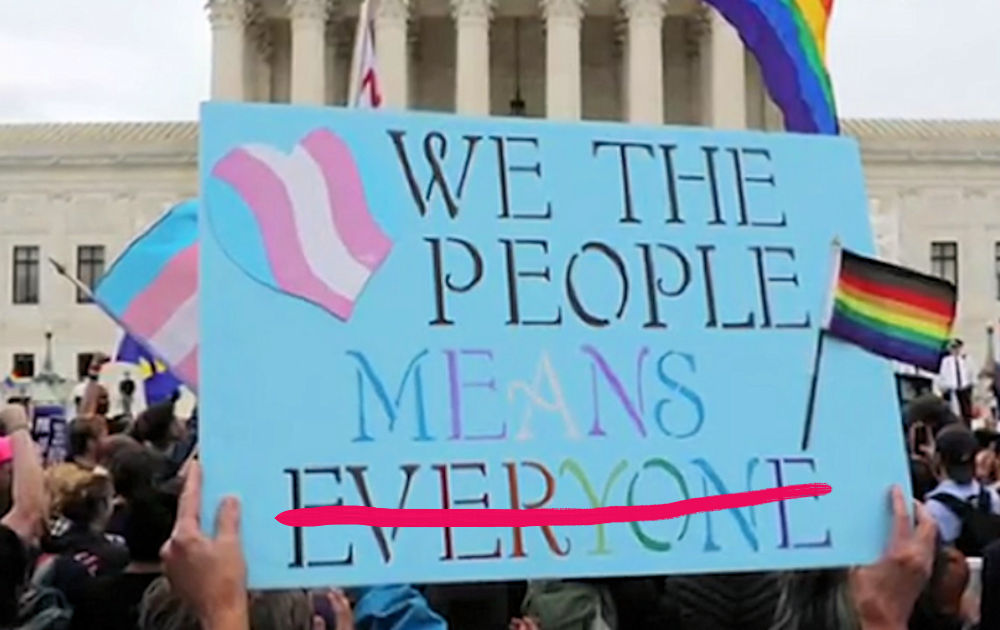
Still not "We The People" for everyone

I'm happy for the LGBTQ community for last Monday's Supreme Court decisions in Bostock v. Clayton County, Ga. and Altitude Express v. Zarda

It's now (actually past time) for the Court to strike down the last major form of discrimination in the United States -- that of Christian privilege of "In G-d We Trust", "under G-d" in the Pledge of Allegiance, oaths with "So Help Me G-d", etc. 

Unless the Court does so, We The People does NOT mean Everyone. 244 years and waiting for America to rid itself of Christian privilege and Christian nationalism.

By: Robert V. Ritter, Founder, Jefferson Madison Center for Religious Liberty, June 16, 2020

Wednesday, February 5, 2020

Trey Smith's "The Choice" - dramatic Christian Apologetics

In response to a comment that I posted on Facebook -- that the Bible is the greatest lie ever told -- one respondent asked me to watch a YouTube video "The Choice." https://youtu.be/S-SzIJngWqE


I watched the 22 minute video to which I replied:

I watched Trey Smith's video "The Choice: God in a Nutshell." I would ask you do what Trey asks at the end:-- "open your eyes." The video is pure Christian Apologetics fantasy. It rests on the false premise: "Yet by definition, the very definition of God with a capital G, is merely the intelligent source from which all creation extends to exist." From this false premise flows the unreality of Jesus as God. A lot of tearful graphics, such as a bloody Jesus on a cross and wolves tearing apart a human carcass, doesn't make any of it true. It just draws the gullible into the fold of misguided believers. For more than 50 of my 70 years I have not been aware of any credible evidence of the existence of a god. If you are aware of any credible evidence, I invite you to share it.
As a retired lawyer with a passion for observation, logic and verification -- reason and science -- evidence must meet a high bar of proof to be credible. Merely alleging that God created the Universe is not proof of the existence of God. Based on the lack of credible evidence of the existence of God, I conclude that the Judeo-Christian-Islamic God does not exist. However, should such evidence come to light before my demise, I will re-evaluate my belief. I do not intend to hold my breath in the meantime.

Thursday, June 20, 2019

Supreme Court Trampels on Religious Freedom

The U.S. Supreme Court trampled upon the First Amendment today, all but abolishing religious freedom in America. In American Legion v. American Humanist Association, No. 17–1717, the Court held that the Bladensburg Cross on public property does not violate the Establishment Clause. This  decision reverses a 4th Circuit decision which held that the display of the preeminent symbol of Christianity on public property does violate the First Amendment. The decision is insane and truly shows how politically Christian Nationalist the Supreme Court has become.

As a footnote, the decision echoes one of the Court's worst decisions of all-time in Van Orden v. Perry (2005), particularly Justice Breyer's "let sleeping dogs lie"concurrence in the judgment opinion.

Robert V. Ritter

 (Disclosure Statement: I served as legal coordinator of AHA from 2007 to 2010.)

.


Thursday, November 1, 2018

Open Letter to Senator Tim Kaine

Dear Senator Kaine,

As a constituent of yours and an adherent to Presidents Thomas Jefferson's and James Madison's constitutional principle of separation of church and state, your senatorial campaign ad alleging that WE are "one nation under God" is most disturbing.

The United States of America has NEVER been a nation under God. Permit me to remind you that you took an oath to uphold and defend the Constitution. The Constitution is clear: "We the People of the United States ... do ordain and establish this Constitution for the United States of America." The United States is a secular nation.

As confirmation, the Constitution makes no mention of a god or gods and gave religion no role to play in our government.

I call upon you to live up to your oath and submit a bill to repeal the 1954 act that added "under God" to the Pledge of Allegiance.

Sincerely,

Robert V. Ritter
Falls Church, VA

Tuesday, October 2, 2018

Kavanaugh Unqualified for Seat on Supreme Court

The American political psyche is very divided. The multitude of views is the nature of the American politick. That was true at our founding and it is true today.

This being said, Judge Brett Kavanaugh is unqualified for a seat on the Supreme Court for a number of reasons. Foremost is his temperament. His behavior during the Senate Judiciary confirmation hearings was atrocious. His response to Senator Klobuchar's questions about his drinking were not only evasive but extremely disrespectful. I can envision Kavanaugh going ballistic during an oral argument should he be confirmed.

Some argue that millions don’t believe Kavanaugh assaulted Ford. On the other hand, millions of Americans believe Christine Blasey Ford's testimony was credible and that he did sexually assault her while he was drunk. Mark Judge has corroborate that Kavanaugh had a drinking problem while he was at Georgetown Prep. And others at Yale said likewise. Also that he was belligerent. There is also a police report concerning Kavanaugh that he was involved in a bar fight. A person who sits on the High Court should be beyond reproach and Kavanaugh is not that person. Too many question marks to say the least.


There is also serious concern that Kavanaugh may have committed perjury -- including, lying about his drinking problem and definition of sex terms.

And on top of all this, he is extremist in is views, and lacks both impartiality and fidelity to the Constitution. For example, his concurrence in Newdow v. Roberts, 603 F.3d 1002 (DC Cir. 2010)  (a case in which I was co-counsel in challenging the religious practices of the 2009 presidential inaugural ceremony) is indicative of Kavanaugh's support for Christian privilege (at the expense of non-theists and persons of minority religions) contrary to the Establishment Clause of the First Amendment.

As a member of the Supreme Court bar and with these points in mind, I am of the opinion Judge Kavanaugh is eminently unqualified for a seat on the Supreme Court.

Robert V. Ritter

Sunday, October 8, 2017

"In God We Trust" and the Fraud of Ceremonial Deism

How is it that the federal government can establish "In God We Trust" as our national motto, print IGWT on our currency and engrave it on our coins, have a Pledge of Allegiance with "one nation under God", military bands play God Bless America, etc.

The answer is quite simple: tyranny of the majority.  While the First Amendment prohibits government sponsorship of religion (i.e. establishments of religion), presidents, congressmen and women and judges and justices lack the courage to enforce it or, worse, are part of the problem.

In the last two weeks, we have two federal court cases with astonishing different results. First, on October 6, courageous U.S. District Court Judge Barbara B. Crabb held that the "parsonage allowance" found in I.R.C. Sec. 107(2) violated the Establishment Clause. The parsonage allowance provision allows "ministers of the gospel" (broadly construed by IRS) to exempt from their income taxes allowances for their housing -- including for mansions, swimming pools and lawn care -- while disallowing the exemption for similarly situated secular persons. Excellent decision in Gaylor v. Mnuchin (W.D. Wisc. Oct. 6, 2017) based on fidelity to the Constitution.

On the other hand, U.S. District Court Judge Amy J. St. Eve obediently whimped out in Mayle v. U.S. (N.D. Ill., Sept. 29, 2017) by regurgitating the sham legal reason of "ceremonial deism" (which states that it's OK for the government to promote the majority religion (i.e., Christianity) by using short phrases such as "In God We Trust," "under God" and "So help me God").

While I find every aspect of the Judge St. Eve's opinion repugnant and contrary to the Constitution, I would like to focus on two points.

First, Judge St. Eve found that compelling Americans to conduct financial transactions with U.S. currency and coins with "In God We Trust" is not a "substantial burden" under the Religious Freedom Restoration Act (RFRA). This is absurd on its face. Because I am an Atheist, I use a black permanent marker to line thru "In God We Trust" on the currency I carry in my wallet. (Too difficult to grind IGWT of coins but I like the idea.) Well, Judge St. Eve, it is at least as much a "substantial burden" as having Christian institutions signing a form saying they don't want to provide contraceptive coverage under the ACA. Actually more so.

Second, Judge St. Eve doesn't understand the Equal Protection argument. In her view, since everyone has to carry the unconstitutional currency, they they are "equal."  That's the wrong comparison.  Rather, the issue is that Congress has shown preference to the majority's religion by mandating a statement of belief in the monotheistic "God" be placed on our coins and currency.  The inequality relates to the Congress's lack of similar endorsements of Atheism and minority religions.  An absolutely blatant violation of the Equal Protection Clause.

The Supreme Court has said in numerous cases that government must remain neutral in matters of religion -- that government may not prefer one religion over another, or religion over nonbelief.  (See, e.g., McCreary County v. ACLU of Kentucky (2005).

Until the Supreme Court rids itself of its morning prayer of "God save this honorable Court" and declares ceremonial deism a sham, Atheists and practitioners of minority religions will continue to be second class citizens in the United States

Robert V. Ritter