Showing posts with label In God We Trust. Show all posts

Sunday, September 19, 2021

Justice for Atheists

People of color and the LGBTQ movements have had their days in the Sun. I support equality. Good for them.

Sadly, the rights of Atheists haven't advanced much since the 1963 prayer cases. Every day, we face the indignity of Christian privilege with the U.S. motto of "In God We Trust," "under God" in the Pledge of Allegiance, oaths with "So help me God" and politicians with "God bless America." I regularly take a black marker and cross "In God We Trust -- which I don't" -- off the currency in my wallet. 

I encourage all Americans who believe in religious freedom as espoused by Presidents Jefferson and Madison to do the same. Congress should repeal the invidious motto and IGWT on currency laws -- for starters.

And then there are Christian crosses and Ten Commandment monuments on public property. Ug. FYI, contrary to statements that the Ten Commandments are displayed on public property in Washington, D.C., there is no English version of the Ten Commandments displayed there, including the courtroom of the Supreme Court. In fact, the Hebrew translation Moses's tablet into English actually commandments people to kill, steal and commit adultery. Fascinating.

Friday, December 11, 2020

Supreme Court: Change Your Morning Prayer

America has a serious problem of Christian privilege -- which starts at the Supreme Court with its morning prayer: "God save the United States and this honorable Court."

Under God" in the Pledge, "In God We Trust" as our motto and "So help me God" in oaths are serious violations of the Establishment Clause of the First Amendment. But don't expect these to change until the Court changes its prayer FIRST. 

In my opinion, this is where the American Humanist Association, Freedom From Religion Foundation, ACLU, Americans United for Separation of Church and State, etc. ought to focus their resources. 

Secularists cannot exterminate the Christian privilege of ceremonial deism unless and until the Supreme Court implements the First Amendment principle that government may not prefer one religion over another or religion over nonbelief. McCreary County v. ACLU of Ky., 545 U.S. 844, 860 (2005).

Mr. Chief Justice, how about: "Oyez! Oyez! Oyez! All persons having business before the Honorable, the Supreme Court of the United States, are admonished to give their attention, for the Court is now sitting.  May this Court have the wisdom to administer equal justice under the law." 

By: Robert V. Ritter, December 11, 2020

Thursday, November 26, 2020

Agenda for Secular America


    I sincerely believe that black lives matter. As do LGBTQ lives. As do the lives of Atheists and all people. That is the foundation of our social contract -- all people are equal under the law.
    Blacks and LGBTQ have had their days in the Sun fighting for justice. It is time us to recognize Christian privilege and its injustice to Atheists and religious minorities..
    To this end, the Jefferson Madison Center for Religious Liberty today announces its Agenda for Secular America and a roadmap to stamp out Christian privilege.
  1. the Supreme Court alter the prayer that opens each session -- G-d save the United States of America and this honorable Court
  2. Amend 36 U.S. Code. § 302 by substituting "In People We Trust," "In Reason We Trust" or "United We Stand for "In G-d We Trust".
  3. Repeal the 1954 addition of "under G-d" to the Pledge of Allegiance (4 U.S.C. § 4).
  4. Repeal 36 U.S. Code § 119 directing the president to issue a National Day of Prayer proclamation annually on the first Thursday in May.
  5. Prohibit military bands playing God Bless America.
  6. Amend 5 U.S. Code § 3331 by removing "So help me G-d" from the oath taken by federal officials (except the president),
  7. Amend 28 U.S. Code § 453 by removing "So help me G-d" from the oath taken by justices and judges.
  8. naturalization oath
  9. Religious Freedom Restoration Act 42 U.S.C. § 2000bb through 42 U.S.C. § 2000bb-4 
  10. No organization receiving funds from the United States of America shall discriminate with respect to the services they provide on the basis of religion or nonbelief., including reproductive services, adoption, food distribution or shelter..
  11. Encourage politicians not to eonclude their speeches with "G-d bless America."
  12. Move religious monuments to public property.
  13. The Houses of Representatives and the Senate hire a secular chaplain or eliminate the chaplain position.
  14. Repeal __ U.S. Code § __ (i.e. remove In G-d We Trust from U.S. currency). 
  15. Repeal __ U.S. Code § __ (i.e. remove In G-d We Trust from U.S. coins).
  16. Repeal the Boy Scouts of America national charter __ U.S. Code § __ if the organization does not eliminate its requirement for belief in a supreme being.
  17. Encourage Little League Baseball and Softball and other quasi organizations to eliminate their requirement for belief in a supreme being.
  18. Repeal I.R.C. § 107 (parsonage allowance).
  19. Enforce the Johnson Amendment prohibiting houses of worship from endorsing a candidate for public office.
By: Robert V. Ritter, Founder, Jefferson Madison Center for Religious Liberty

Tuesday, June 16, 2020

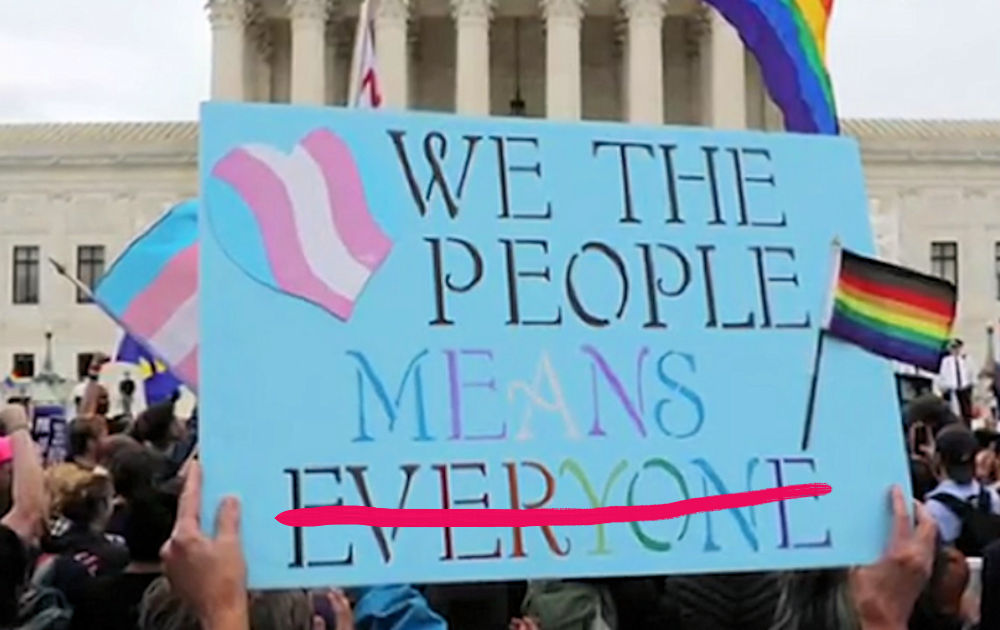
Still not "We The People" for everyone

I'm happy for the LGBTQ community for last Monday's Supreme Court decisions in Bostock v. Clayton County, Ga. and Altitude Express v. Zarda

It's now (actually past time) for the Court to strike down the last major form of discrimination in the United States -- that of Christian privilege of "In G-d We Trust", "under G-d" in the Pledge of Allegiance, oaths with "So Help Me G-d", etc. 

Unless the Court does so, We The People does NOT mean Everyone. 244 years and waiting for America to rid itself of Christian privilege and Christian nationalism.

By: Robert V. Ritter, Founder, Jefferson Madison Center for Religious Liberty, June 16, 2020

Sunday, October 8, 2017

"In God We Trust" and the Fraud of Ceremonial Deism

How is it that the federal government can establish "In God We Trust" as our national motto, print IGWT on our currency and engrave it on our coins, have a Pledge of Allegiance with "one nation under God", military bands play God Bless America, etc.

The answer is quite simple: tyranny of the majority.  While the First Amendment prohibits government sponsorship of religion (i.e. establishments of religion), presidents, congressmen and women and judges and justices lack the courage to enforce it or, worse, are part of the problem.

In the last two weeks, we have two federal court cases with astonishing different results. First, on October 6, courageous U.S. District Court Judge Barbara B. Crabb held that the "parsonage allowance" found in I.R.C. Sec. 107(2) violated the Establishment Clause. The parsonage allowance provision allows "ministers of the gospel" (broadly construed by IRS) to exempt from their income taxes allowances for their housing -- including for mansions, swimming pools and lawn care -- while disallowing the exemption for similarly situated secular persons. Excellent decision in Gaylor v. Mnuchin (W.D. Wisc. Oct. 6, 2017) based on fidelity to the Constitution.

On the other hand, U.S. District Court Judge Amy J. St. Eve obediently whimped out in Mayle v. U.S. (N.D. Ill., Sept. 29, 2017) by regurgitating the sham legal reason of "ceremonial deism" (which states that it's OK for the government to promote the majority religion (i.e., Christianity) by using short phrases such as "In God We Trust," "under God" and "So help me God").

While I find every aspect of the Judge St. Eve's opinion repugnant and contrary to the Constitution, I would like to focus on two points.

First, Judge St. Eve found that compelling Americans to conduct financial transactions with U.S. currency and coins with "In God We Trust" is not a "substantial burden" under the Religious Freedom Restoration Act (RFRA). This is absurd on its face. Because I am an Atheist, I use a black permanent marker to line thru "In God We Trust" on the currency I carry in my wallet. (Too difficult to grind IGWT of coins but I like the idea.) Well, Judge St. Eve, it is at least as much a "substantial burden" as having Christian institutions signing a form saying they don't want to provide contraceptive coverage under the ACA. Actually more so.

Second, Judge St. Eve doesn't understand the Equal Protection argument. In her view, since everyone has to carry the unconstitutional currency, they they are "equal."  That's the wrong comparison.  Rather, the issue is that Congress has shown preference to the majority's religion by mandating a statement of belief in the monotheistic "God" be placed on our coins and currency.  The inequality relates to the Congress's lack of similar endorsements of Atheism and minority religions.  An absolutely blatant violation of the Equal Protection Clause.

The Supreme Court has said in numerous cases that government must remain neutral in matters of religion -- that government may not prefer one religion over another, or religion over nonbelief.  (See, e.g., McCreary County v. ACLU of Kentucky (2005).

Until the Supreme Court rids itself of its morning prayer of "God save this honorable Court" and declares ceremonial deism a sham, Atheists and practitioners of minority religions will continue to be second class citizens in the United States

Robert V. Ritter

Sunday, January 11, 2015

The Answer to Christian Preference is "Blowin' In The Wind"

This afternoon I was listening to Bob Dylan's 1962 song Blowin' In The Wind. One part of the lyrics hit a particular chord for me:

   How many years can some people exist
   Before they're allowed to be free?

   Yes, and how many times can a man turn his head
   And pretend that he just doesn't see.
   The answer, my friend, is blowin' in the wind,
   The answer is blowin' in the wind.

Dylan thought the answer to our peace, war and freedom problems were simple, yet hard to grasp -- like a piece of paper blowing in the wind.

Similarly, the answer to discrimination against LGBTs and Atheists in America is quite simple -- end discrimination.  After all, equality is a core American value.

Unfortunately, the realization of equality is incredibly elusive; it is blowing in the wind. People talk equality, but many have a psychological need to feel superior to others and manifest this thru discrimination and domination.

On a positive note, 2014 was a banner year for progress in support of gay marriage with 37 states and the District of Columbia now issuing marriage licenses to gay couples.

Atheists continue to suffer the indignity of Christian preference throughout the nation -- from "In god We Trust" on our coins and currency to oaths with "so help me god" to the Pledge of Allegiance with "under god" -- all not withstanding the First and Fourteenth Amendments prohibiting preference of one religion over another, or religion over nonbelief.

53 years after Dylan's Blowin' In The Wind, heads are still turned and the answer to discrimination blowin' in the wind.

Monday, January 27, 2014

Response to Cambria Queen's article: Is God in the United States?

Cambria D. Queen wrote a law article (Arizona Summit Law School) titled Is God in the United States? A PDF is available on SSRN at http://papers.ssrn.com/sol3/papers.cfm?abstract_id=2382189.

I emailed her the following comments in rebuttal:


I am disappointed with your historical revisionism, faux legal analysis and improper citations.

First, the term "God" is inherently religious and its use by government in the manner your article supports necessarily violates the Establishment Clause of the First Amendment and the Equal Protection Clause of the Fourteenth Amendment. The failure in most instances of the Supreme Court to recognize this is reflective of the Court's infidelity to the Constitution and pandering to the majority.

Second, historical revisionism permeates your article. For example, I would note that the insertion of "under God" in the Pledge of Allegiance has nothing to do with patriotism and everything to do with religion -- specifically, it was an anti-Atheism slogan promoted by the Catholic organization Knights of Columbus. The organization was initially unsuccessful in getting inserted into the Pledge in 1952, but was ultimate successful in 1954.

Similarly, legislation to make "In God We Trust" was promoted by Christian evangelicals against Atheism. Having lost the war when the Constitution made the U.S. a secular nation, the Christian Right continue to fight battles in their effort to make the U.S. a Christian Nation.

Third, your use of Lemon v. Kurtzman is ironic. The 8th Circuit in Plattsmouth withheld rendering its decision until after a decision in Van Orden v. Perry. As you may be aware, there was no majority decision in Van Orden. Justice Breyer cast the deciding vote and his opinion primarily rested on the fact that the Fraternal Order of Eagles' donated monument had been on the Texas state capitol grounds for 40 years before being challenged. It did NOT rest on a bona fide Lemon analysis. To the contrary, Breyer switched sides in McCreary County which applied a Lemon analysis in holding that the display of the Ten Commandments in the McCreary County Courthouse violated the Establishment Clause. Thus Plattsmouth should be viewed as Van Orden II -- as well as, a misapplication of Lemon.

Fourth, footnote 28 "McCreary Cnty. v. ACLU of Ky., 545 U.S. 844, 887-89 (2005)." fails to note that pages 887-89 are from Justice Scalia's dissenting opinion. As cited, the reference implies that it is from Justice Souter's majority opinion. 

Fifth, you failed to site the majority holdings in McCreary and Stone v. Graham (1980). Those cases held that the display of the Ten Commandments on public property violated the Establishment Clause. Moreover, the Supreme Court recently declined certiorari in the Mount Soledad and Utah cross cases in which appeals courts held that the display of Christian crosses on public property violate the Establishment Clause.

And as a final point, I am disappointed that you failed to advance Thomas Jefferson's separation of church and state principle. If Jefferson were on the Supreme Court today he would surely hold "under God" in the Pledge, the U.S. motto of "In God we trust", Ten Commandment Monuments and Christian Crosses on public property, etc. violate of the First Amendment.

Monday, September 30, 2013

Myth #5: We've Continuously Acknowledge God Since 1789


[Chapter 9, post #7]
[Updated 10/1/2013]

“There is an unbroken history of official acknowledgment by all three branches of government of the role of religion in American life from at least 1789.”
Chief Justice Rehnquist[1]

Presidents, members of Congress and even justices of the Supreme Court have been infusing religion into government since the founding of this country.  But is the infusion an “unbroken history” as the Chief Justice is quoted above.  And, more importantly, is it proper? 

I readily concede that religion in its many forms appears throughout our history.  However, Justice Stevens notes in his dissenting opinion: “The plurality’s reliance on early religious statements and proclamations made by the Founders is . . . problematic because those views were not espoused at the Constitutional Convention in 1787 nor enshrined in the Constitution’s text.”[2]  In short, the Chief Justice’s line of argument is largely irrelevant. 

However, to the extent that it has an iota of relevance to Van Orden, it is also important to mention that presidents, members of Congress and justices of the Supreme Court had the opportunity to infuse religion into government but declined to do so because it is prohibited under the Establishment Clause.  For example, President Jefferson declined to issue Thanksgiving Proclamations believing that to do so would violate the Establishment Clause.  Chief Justice’s chain of official acknowledgments has been broken innumerable times.  Certainly, the Supreme Court decisions in West Virginia v. Barnette,[3] McCollum v. Board of Education,[4] Torcaso v. Watkins,[5]  Abington School District v. Schempp,[6] Stone v. Graham[7] and McCreary County v. ACLU of Kentucky[8] and the 1960 speech of Senator John F. Kennedy in which he said “I believe in an America where the separation of church and state is absolute”[9] are chain breakers. 

To further Justice Steven’s point, the meaning of the Establishment Clause is not determined by which Secularists, Christian Nation evangelists or any other faction has the longer list of government acknowledgments.  Rather, it is determined by which maintains fidelity to the Constitution. 

Fidelity to the Constitution is not to be had from Chief Justice Rehnquist employing bait and switch arguments, including: “Simply having religious content or promoting a message consistent with a religious doctrine does not run afoul of the Establishment Clause.”[10]  “Simply having religious content” (with nothing more) suggests something minimal or innocuous – a tree lost in a forest.  Probably not a problem.  Contrast this with “promoting a message consistent with a religious doctrine.”  The latter is unquestionably government endorsement of religion in violation of the Establishment Clause.  Think the Texas Ten Commandments monument – a sequoia in a forest of small trees. 

Under our Constitution, the federal government was granted no role to play in the religious sphere.[11]  The Christian Right – having lost out in its efforts in the Constitutional Convention and the First Congress to establish a Christian Nation – has not given up. Thus, 222 years after the adoption of the Establishment Clause, we still have government endorsement after endorsement of religion including the following unconstitutional acknowledgments that cry out for immediate attention: 


1.      The Supreme Court open its sessions with: "Oyez!  Oyez!  Oyez!  All persons having business before the Honorable, the Supreme Court of the United States, are admonished to draw near and give their attention, for the Court is now sitting.  God save the United States and this Honorable Court." (Emphasis added.)
2.      Each chamber of Congress opening its session with a prayer.[12]
3.      The oath administrator adding “so help me God” to the presidential oath.[13]
4.      “In God We Trust” as the motto of the United States.[14]
5.      “Under God” in the Pledge of Allegiance.[15]
6.      “In God We Trust” printed on our currency[16] and stamped on our coins.[17]
7.      Presidents and politicians ending their speeches with “God bless America.”[18]
8.      Federal funding of religion under the rubric of social services and economic development.
9.      Religious monuments (e.g., Ten Commandments, Christian crosses) on public property.
10.  Government led prayers in public schools, including graduation ceremonies and sporting events.
11.  Insertion of Creationism or Intelligent Design into public school courses.
12.  Witness and other oaths ending “so help me God.”
13.  Military bands playing “God Bless America.”[19]

The Christian Right and the Van Orden majority, like everyone else, must obey the law of the land.  The Eagles-donated Ten Commandments monuments and the above so-called religious acknowledgments religious must be stopped if we are to realize the dream of religious freedom in America. 


[1]  Quoting Lynch v. Donnelly, 465 U.S. 668, 674 (1984).
[2]  Van Orden, (Stevens, dissenting) at 724.
[3]  West Virginia State Board of Education v. Barnette, 319 U.S. 624 (1943) (held that the Free Speech Clause of the First Amendment protected students from being forced to salute the American flag and say the Pledge of Allegiance in school).
[4]  McCollum v. Board of Education, 333 U.S. 203 (1948)
[5]  Torcaso v. Watkins, 367 U.S. 488 (1961) (held that Article VI of the Constitution prohibits states and the federal government from requiring any kind of religious test for public office).
[6]  Abington School District v. Schempp, 374 U.S. 203 (1963) (holding school-sponsored Bible reading in public schools to be unconstitutional).
[7]  Stone v. Graham, 449 U.S. 39 (1980) (held a Kentucky statute requiring the posting of a copy of the Ten Commandments on the wall of each public classroom in the state violated the Establishment Clause).
[8]  McCreary County v. ACLU of Ky., 545 U.S. 844 (2005).
[9]  Address of Senator John F. Kennedy to the Greater Houston Ministerial Association, September 12, 1960. Available at: http://www.jfklibrary.org/Asset-Viewer/ALL6YEBJMEKYGMCntnSCvg.aspx.
[10]  Van Orden, at 690.
[11]  Under the Due Process Clause of the Fourteenth Amendment, that limitation applies to the states.  Everson v. Board of Education, 330 U.S. 1 (1947).
[12]  Marsh v. Chambers, 463 U.S. 783 (1983) – the Court held in a 6-3 decision that Nebraska’s funding for legislative chaplains was constitutional because of the "unique history" of the United States.  In my opinion, “unique history” is a sham legal argument to circumvent the prohibitions of the First and Fourteenth Amendments.
[13]  The addition of “so help me God” to the presidential oath violates Article II, sec. 1, cl. 8 of the Constitution which prescribes the specific wording of the oath.  I served as co-counsel in Newdow v. Roberts, a federal lawsuit which challenged the unconstitutional religious practices of the 2008 presidential inaugural ceremony.  The U.S. District Court held that over 250 plaintiffs standing to challenge the religious practices and the U.S. Court of Appeals for the D.C. Circuit affirmed – both, in my view, wrongly holding that the plaintiffs had not suffered the degree of harm required by Article III’s “case and controversy” requirement.

[14]  36 U.S.C. § 302 establishes “In God We Trust” as the national motto.

[15]  4 U.S.C. § 4 specifies the wording of the in the Pledge of Allegiance, including the words “Under God.”
[16]  31 U.S.C. § 5114 mandates “In God We Trust” be printed on U.S. currency.

[17]  31 U.S.C. § 5112 mandates “In God We Trust” be stamped on U.S. coins.

[18]  Here, the Constitution is not violated because the statements are protected by the under the Free Speech Clause of the First Amendment as private speech.  However, in my view, the statements violate the spirit of the Constitution and stigmatize persons of different religions or of no religion as political outsiders.
[19]  I was horrified when I personally witnessed the Marine Corps band playing God Bless America prior to the start of the 2004 U.S. Open Tennis Championship in New York.  If that is not an endorsement of religion, I don’t know what is.

Wednesday, September 11, 2013

Judge ignores reality in IGWT motto case

U.S. District Court Judge Harold Baer, Jr. handed down an incredibly Christian Right themed decision in a New York case challenging the inscription of "In God We Trust" on our currency and coins.

In dismissing Newdow v. United States (N.D. N.Y., September 9, 2013), Judge Baer noted that the Supreme Court and four circuit courts have "assumed the motto's secular purpose and effect." And that's the problem.

First, the Supreme Court has never held on the merits that the "In God We Trust" on our currency or coins (or "under God" in the Pledge) is constitutional under the Establishment Clause of the First Amendment.

Second, the cases that Judge Baer cites in support of his opinion employ historical revisionism. The IGWT motto (and "under God" in the Pledge") legislation was promoted in the 1950s (during the Second Red Scare) by the Christian Right to put government's imprimatur of god-belief through the use of our motto (and the Pledge of Allegiance).

Judge Baer's decision references typical (and not so typical) secular purposes of "the legitimate secular purposes of solemnizing public occasions, expressing confidence in the future, and encouraging the recognition of what is worthy of appreciation in society." (Citing Justice O'Conner's concurring opinion in Lynch v. Donnelly.)

Make no mistake about it: these are all sham secular purposes. The IGWT motto has but one purpose -- it's a backdoor approach by the Christian Right to subvert our secular Constitution by turning our country into a Christian Nation. (American Christian fundamentalism has striking parallels to fundamentalist Islam of the Middle East.)

There are many truly secular ways of solemnizing our currency, such as, using the "E pluribus unum" ("Out of many, one") that is on the Seal of the United States.

Does IGWT express confidence in the future? This is too ridiculous a purpose to elaborate upon.

And what does IGWT recognize as "worthy of appreciation" -- but God (to the Christian Right)! Clearly, to a reasonable, objective observer, "In God We Trust" is totally a religious expression with no redeeming secular value. I would also note that more than twenty percent of Americans do not trust (or believe) in the Judeo-Christian god.

Third, Judge Baer also lists "ceremonial deism" as a reason for his holding. The term was coined in 1962 by Eugene Rostow, then dean of Yale Law School. Although used the Supreme Court since 1984 as a justification for exempting various religious acts by government from the prohibitions of the First Amendment, it is a legal fiction that has no rational basis in the Constitution. Indeed, there is not a single reference to "God" in the Constitution.

Accordingly, from the same set of facts as before the court in Newdow, it is clear to me that the legislation directing the inscription of "In God We Trust" on our currency had a singularly religious purpose and its principal or primary effect has been to advance Christianity. In addition, because we use currency and coins daily in our financial affairs, I would also argue that the inscription of IGWT on our currency and coins excessively entangles government in religion. (NOTE: The plaintiffs in Newdow did not make the latter argument.)

In my opinion, IGWT as an official motto and its inscription on our currency and coins violates all three prongs of the Lemon test and, therefore, its use should be declared by the courts as unconstitutional under the Establishment Clause.